


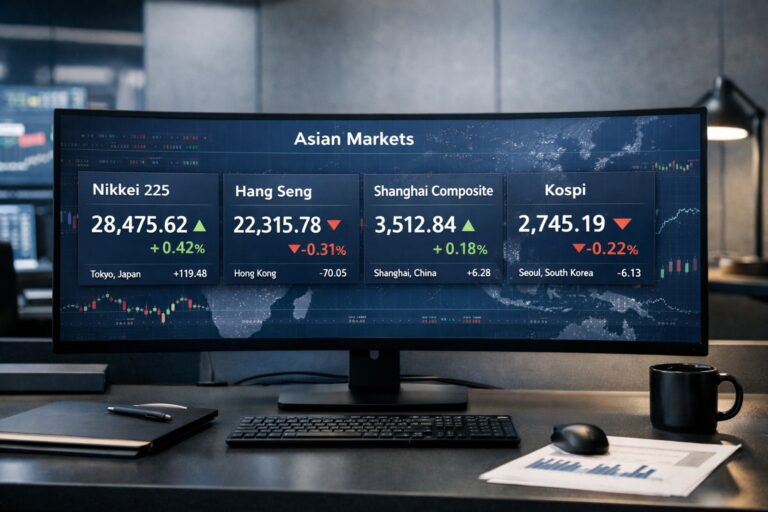

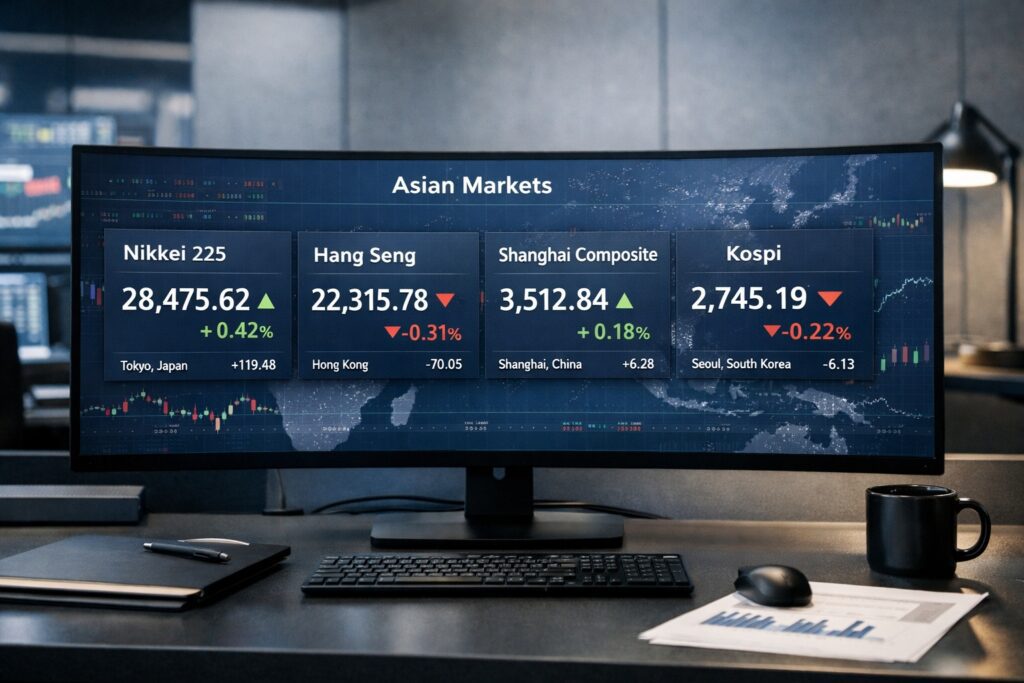
Asian markets today are trading in a mixed but stable pattern, with major benchmarks across Japan, Hong Kong, mainland China, and South Korea responding to global rate expectations, currency movements, and domestic economic signals. Technology shares remain influential, while investors are carefully assessing policy guidance and corporate earnings to determine near-term direction.
Asian equities opened the session with selective strength rather than broad rallies. The tone across the region reflects cautious positioning as global investors balance optimism around technology demand with uncertainty surrounding monetary policy and growth sustainability. Those tracking FintechZoom.com Asian markets today are focused not only on index levels but also on the underlying drivers shaping sentiment.
Major Asian Indices Overview
| Index | Market | Key Influence | Current Bias |
|---|---|---|---|
| Nikkei 225 | Japan | Yen movement, exporter earnings | Firm tone |
| Hang Seng Index | Hong Kong | China policy outlook, tech sector | Volatile |
| Shanghai Composite | China | Stimulus measures, domestic demand | Policy-driven |
| Kospi | South Korea | Semiconductor cycle | Gradual recovery |
Japan: Export Advantage and Currency Impact
Japan’s Nikkei 225 continues to draw foreign investor interest. Export-focused companies are benefiting from currency dynamics that enhance overseas competitiveness. A softer yen improves revenue conversion for multinational firms, especially in the automotive and industrial technology sectors.
At the same time, market participants remain attentive to domestic monetary policy signals. Any adjustment in central bank stance could influence currency stability and capital flows. For now, earnings resilience is helping support valuations.
Hong Kong: Liquidity Sensitivity and Sentiment Shifts
The Hang Seng Index reflects evolving investor confidence toward mainland China and global liquidity conditions. Technology and financial shares frequently dictate daily direction. Short-term rallies often emerge when overseas markets perform strongly, while caution returns quickly when macro data disappoints.
Property-related names remain highly reactive to regulatory signals. This contributes to episodic volatility, making Hong Kong one of the more sentiment-sensitive markets in the region.
Mainland China: Policy as the Primary Driver
The Shanghai Composite is closely tied to fiscal direction and structural reform signals. Investors continue to evaluate stimulus initiatives aimed at strengthening domestic consumption and supporting industrial output.
Institutions such as the International Monetary Fund have emphasized in recent regional outlook assessments that sustainable growth in China depends on balanced economic reforms and productivity improvements. Markets respond positively when policy measures align with long-term development objectives.
However, durable rallies require consistent implementation rather than short-term announcements.
South Korea: Technology and the Semiconductor Cycle
South Korea’s Kospi remains closely linked to semiconductor demand and global technology spending. As artificial intelligence infrastructure investment expands and memory chip prices stabilize, investor interest in major exporters has strengthened.
Recent sessions suggest a rebuilding phase rather than an aggressive rally. Confidence is returning gradually, supported by improving global tech sentiment.
Sector Rotation Beneath Index Headlines
While headline indices provide a snapshot, deeper analysis reveals sector-level divergence. Technology continues to lead performance in Japan and South Korea. Financial stocks are reacting to bond yield movements and shifting rate expectations. Energy shares track commodity price trends, while consumer sectors depend heavily on domestic spending stability.
Investors are paying close attention to market breadth. Broader participation across sectors generally signals healthier momentum compared to rallies driven by a small cluster of large-cap names.
Currency Trends and Cross-Border Capital Flows
Foreign exchange remains central to equity performance. A stronger U.S. dollar can tighten financial conditions for emerging markets in Asia, while currency stability often encourages greater risk appetite.
Global funds continue to adjust allocations dynamically. Exchange-traded products tracking Asian benchmarks experience inflows when global growth confidence improves and outflows during periods of heightened uncertainty.
For readers looking to explore the subject further, a more comprehensive perspective is available through this in-depth regional markets insight, which takes a deeper look at cross-market trends, sector positioning, and the broader forces influencing Asian equities.
What Could Move Asian Markets Next
Several variables remain in focus. U.S. Federal Reserve commentary continues to influence global liquidity expectations. Chinese economic data releases may shift policy outlook assumptions. Corporate earnings updates across Asia will provide clearer visibility into demand trends.
Geopolitical developments across the Asia-Pacific region also remain a consideration. Markets tend to react swiftly to unexpected headlines, reinforcing the importance of disciplined positioning.
Broader Perspective
Asian markets represent a critical component of the global financial system. Developments in Tokyo, Hong Kong, Shanghai, and Seoul frequently influence trading sentiment in Europe and North America within hours.
At present, the regional environment reflects cautious optimism. Japan benefits from export strength, Hong Kong remains liquidity-sensitive, mainland China is policy-driven, and South Korea’s trajectory depends largely on the semiconductor cycle.
Understanding FintechZoom.com Asian markets today requires looking beyond index numbers and focusing on the structural drivers beneath the surface. In a globally interconnected environment, context remains the most valuable tool for interpreting daily price action.